Choosing the right educational path for your child is one of the most important decisions you will make, and understanding your options in Canada is the first step.
When comparing Canadian public schools with progressive Montessori schools, the core difference lies in how children learn. Public schools follow a structured, top-down provincial curriculum in which a teacher directs the entire class through the same material at a uniform pace, using single-age classrooms and standardized grades.
In contrast, Montessori schools feature multi-age classrooms where children learn through independent exploration, using specialized tactile materials during long, uninterrupted work blocks that allow them to master concepts at their own unique pace.
Ultimately, public schools focus on achieving uniform group benchmarks, while Montessori focuses on cultivating your child’s individual autonomy, deep focus, and self-motivation. Below is a brief five-point comparison of Canadian public schools and Montessori schools highlighting the core differences in how children are taught and learn.
Canadian Public Schools vs Montessori Schools
1. How does classroom structure differ between public and Montessori schools?
- Public Schools: Children are strictly segregated into classrooms by birth year. Learning centers on the teacher, who guides the entire class through identical content at a uniform pace.
- Montessori Schools: Classrooms rely on multi-age groupings covering a three-year developmental span (such as Casa for ages 3–6). This multi-age design is deliberate; it lets younger children learn naturally from older peers, while older children strengthen their leadership and academic skills by mentoring younger ones.
2. What kind of learning materials and teaching methods are used?
- Public Schools: Instruction leans on abstract delivery, utilizing tools like textbooks, teacher-led lessons, digital technology, worksheets, and memorization-based assessments. Desks or tables typically face the front of the room where the teacher directs the day’s predetermined subjects.
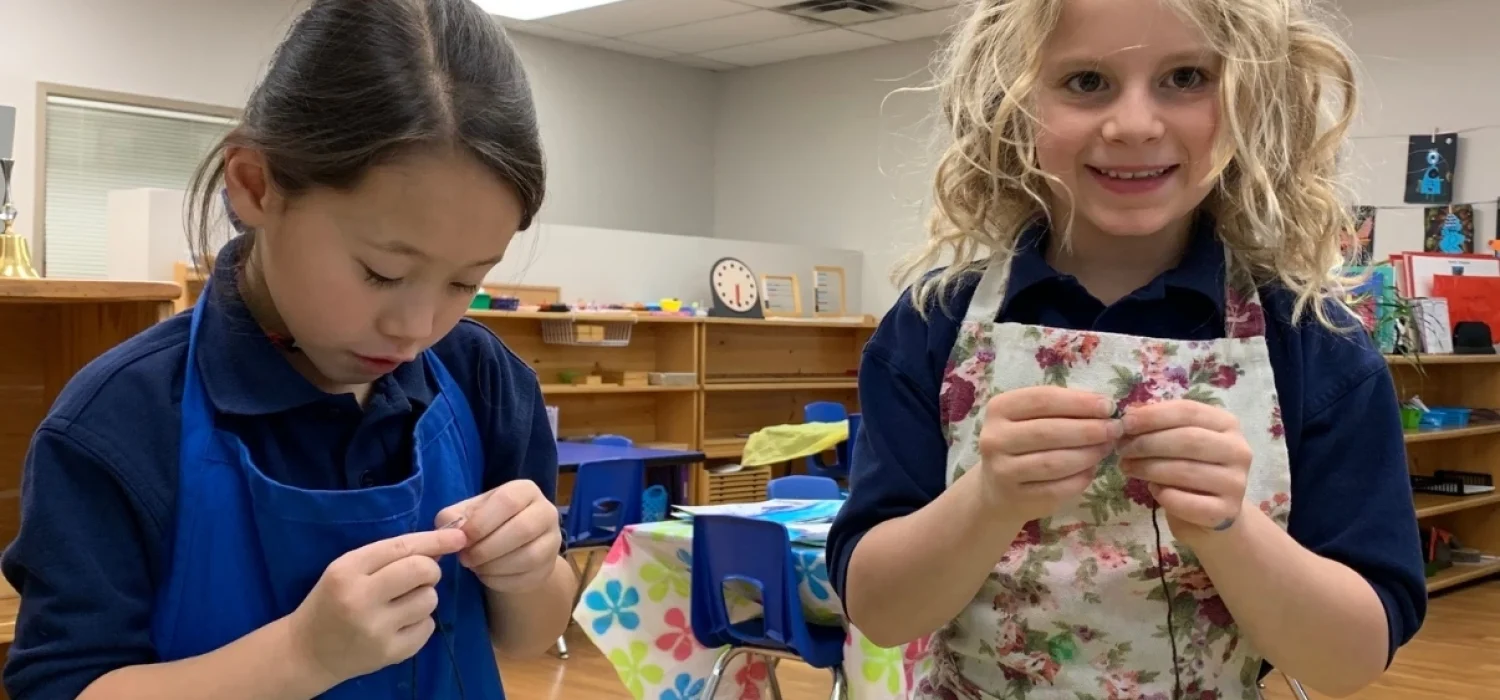
- Montessori Schools: Students have the freedom to move and choose the order of their work from a meticulously prepared environment. They interact with specialized, self-correcting tactile materials (like the Pink Tower or Golden Beads) that transform abstract concepts into concrete, physical reality before transitioning to abstract thought.
3. How do the roles of teachers differ?
- Public Schools: Teachers are the primary instructor and central authority figure. Teachers lead whole-class instruction, delivering uniform lessons to the whole group. Teachers maintain classroom structure and manage behaviour through collective rules, structured transitions and set schedules.
- Montessori Schools: The teacher acts as a guide and observer who sits at the child’s level. The teacher invites individual students to materials with built-in lessons that match the students’ current developmental needs. Students can continue to work with these materials, driving their own learning.
4. How are schedules and time structured?
- Public Schools: The day is divided into short study periods dictated by the school (e.g., 40 minutes for math). Children must stop what they are doing and switch tasks when told, regardless of their understanding or engagement level.
- Montessori Schools: Days feature extended, uninterrupted three-hour work blocks. Children can choose activities, take their time selecting a task, and practice until they achieve mastery. This approach avoids disruption and fosters sustained concentration.
5. How are progress and motivation evaluated?
- Public Schools: Student progress relies on external evaluators like report cards, percentage grades, and provincial standardized testing, which can foster peer comparison and academic stress.
- Montessori Schools: Assessment is continuous and qualitative, tracked through the teacher’s detailed observations of a child’s developmental progress. There are no letter grades; instead, children develop internal motivation, taking pride in their own mastery rather than working for external praise or rewards.
How will Avalon help my child thrive?
The five core Montessori concepts described above work together to create a school community where children do not just learn but thrive intellectually, socially, and emotionally. By shifting the focus from uniform instruction to individual development, the Montessori method builds foundational life skills that last far beyond the classroom.
Here is how each key concept directly supports your child’s growth.
1. How will multi-age classrooms help my child build confidence and make friends?
- Natural Mentorship: Younger children watch older peers tackle advanced work, sparking curiosity and giving them a clear, visible blueprint for what they can achieve next.
- Leadership Skills: When older children mentor younger classmates, they are not just being helpful; they are reinforcing their own academic mastery and building deep empathy, responsibility, and leadership skills.
- Relief from Peer Pressure: Because the classroom spans three ages, the social pressure to match a single, rigid “grade level” standard disappears. Children interact based on shared interests and developmental readiness rather than birth year.
2. How do tactile materials help my child learn complex concepts?
- Deep Conceptual Mastery: Because materials are physical and tactile (like holding a single golden bead for “1” versus a heavy cube of a thousand beads for “1,000”), math and language are not just symbols on a page. Children literally feel and see the logic, leading to deep, permanent understanding rather than temporary memorization.
- The Freedom to Learn from Mistakes: Many Montessori materials are self-correcting. If a puzzle piece doesn’t fit or a cylinder is left over, the material itself shows the error. This teaches children that mistakes are neutral, valuable learning tools, freeing them from the fear and judgment of being wrong in front of other students or a teacher.
3. How does a Montessori teacher guide my child?
- Tailored Academic Pacing: Your child is never held back to wait for a class to catch up, nor are they rushed through a concept they haven’t fully grasped. The teacher introduces new lessons precisely when your child is uniquely ready for them.
- Ownership of Learning: Because the educator acts as a supportive guide rather than a strict commander, children quickly realize that they are the authors of their own day. This shifts their mindset from “I have to do this because the teacher said so” to “I am choosing to do this because I want to know how it works.”
4. How do uninterrupted work blocks teach my child focus?
- Cultivating Deep Focus: In an age dominated by constant digital distractions, cultivating deep focus is an invaluable skill. Extended, unbroken work periods create space for natural concentration, allowing children to become completely immersed in meaningful, self-directed tasks.
- The Gift of Time: When children can work on a challenging task for as long as they need, without a school bell cutting them off, they build stamina, patience, and the profound satisfaction of seeing a difficult project through to completion.
5. How does continuous assessment keep my child motivated to learn?
- Joy in the Process: Without the looming threat of letter grades or public comparison, children maintain their innate, natural desire to learn. They read, calculate, and explore because it is inherently satisfying, not to chase an ‘A’ or avoid an ‘F’.
- Authentic Self-Worth: Because progress is measured against their own past performance rather than a provincial average, children develop a stable, resilient sense of self-worth based on real, personal growth.
Ok but teachers are busy; can they really help my child?
In a traditional classroom, a teacher spending time with one student usually means 25 other children are waiting or off-task.
Montessori teachers can support your child more closely because the classroom design frees them from constant group management. They don’t spend the day managing behaviour from the front of the room; instead, they spend it observing and giving brief, highly targeted individual lessons.
Here is exactly how Montessori teachers manage to support your child effectively without getting overwhelmed.
1. What makes a Montessori classroom different?
In a public school, the teacher must constantly deliver content, or learning stops. A Montessori classroom is designed to run itself.
- Self-Directed Layout: Every piece of material is highly organized, complete, and placed on low shelves within the children’s reach.
- The Materials Teach: Because the tactile materials are self-correcting, a child knows immediately if they made a mistake. They don’t need to raise their hand and wait for a busy teacher to correct them or grade their work; the material itself guides them to the correct answer.
2. How does a Montessori teacher teach everyone?
Instead of standing at the front of a class of children doing the same thing at the same time, a Montessori teacher moves quietly around the room, giving brief lessons called presentations to an individual child or a small group.
- Precision Teaching: Teachers introduce a specific concept when your child is on the exact cusp of understanding it.
- Independent Mastery: After the lesson, the teacher steps back. Your child is then free to work with that material independently, while the teacher moves on to help another student.
3. Will a Montessori teacher help my child learn to focus?
Because the children are deeply engaged in their chosen work, the teacher is freed from constant crowd control. This lets them spend significant time on something traditional teachers rarely have time for: scientific observation.
- Tracking Growth: Teachers keep meticulous records of your child’s daily choices, attention span, and frustration levels.
- Proactive Adjustments: If the teacher notices your child is avoiding math or repeating an easy language task over and over, they don’t yell or lecture. They use what they’ve observed to gently step in and introduce new, exciting material that bridges the gap.
4. I want my child to be seen by their teacher, can Montessori help?
In the Canadian public school system, a teacher gets to know your child’s personality, strengths, and quirks, only to hand them off to a new teacher 10 months later.
- No Learning Curve: Because Montessori classrooms operate in three-year age cycles, your child keeps the same teacher for three full years.
- Deep Trust: The teacher doesn’t waste September figuring out how your child learns. They already know your child’s exact academic baseline, emotional triggers, and personal interests, so they can provide seamless, continuous support from day one of the school year.
Ultimately, Montessori teachers can give your child deep, meaningful attention because they aren’t trying to force 25 unique children onto the exact same page at the exact same second. They act as facilitators of your child’s own natural drive to learn.
How will Montessori prepare my child for the future?
One of the most important underlying principles of a Montessori education involves helping children develop an awareness that everything in the universe is connected and interdependent and forms a harmonious whole and that they themselves are part of and contribute to that whole. Maria Montessori called this the cosmic education.
Cosmic education prepares kids for the future by teaching them to think in systems, adapt to rapid change, and solve complex global challenges. Instead of teaching subjects in isolated silos, this approach shows children how history, science, geography, and human contribution intersect. This mindset is exactly what the future demands.
Will my child learn to think and solve problems?
The future requires tackling interconnected global issues like climate change, economic shifts, and public health.
- Montessori Principle: Montessori education prepares students for complex global challenges by replacing isolated subject memorization with systems thinking, self-directed problem solving, and collaborative leadership. Rather than treating climate, economics, and health as separate topics, the method mirrors how these systems interact in the real world. Cosmic education teaches children to look at the “whole” before studying the “parts.”
- The Future Skill: Kids learn to see patterns, understand cause and effect across networks, and see how a change in one area affects another. Our students become adults who don’t just fix symptoms; they solve root problems.
Will my child learn to work with others?
As AI and automation handle more technical tasks, uniquely human skills like empathy and collaboration become premium assets.
- Montessori Principle: Students learn that all humans and natural systems are interdependent; children develop a deep sense of gratitude and respect for others. Daily classroom routines emphasize caring for the shared environment and resolving conflicts peacefully. This learning expands into leading community service projects, giving students practical experience in sustainable economics and civic responsibility.
- The Future Skill: This fosters a collaborative mindset over a purely competitive one. We build adults who can work across diverse, multicultural teams and navigate complex social landscapes with empathy. Our students will know how to learn, unlearn, and adapt when economic or technological landscapes shift.
Will my child become a global citizen?
The next generation will bear the responsibility of environmental stewardship and global cooperation.
- Montessori Principle: Caring for the natural world is a daily practice for Montessori students, not a theoretical lesson. Children care for classroom plants, tend school gardens, compost, and learn about resource conservation, fostering an early, personal commitment to environmental responsibility.
- The Future Skill: It creates an organic, deeply ingrained commitment to sustainability and corporate social responsibility, rather than treating “being green” as a checkbox or marketing trend. Our students have an innate understanding that humans are part of nature, not separate from it, and that our choices echo across the planet.
Will my child be prepared for future careers?
Career paths are no longer linear; adaptability is the ultimate survival tool.
- Montessori Principle: Montessori classrooms prioritize intrinsic motivation, critical thinking, and independent research; students graduate with the agency and resilience needed to navigate rapid economic and societal shifts.
- The Future Skill: When children are anchored by a sense of purpose and a clear understanding of their value to society, they develop psychological resilience. Our children don’t just learn what to think; they learn how to learn, making them highly adaptable as industries evolve.
Final thoughts
Choosing an educational path is ultimately about preparing your child not just for school, but for life. Montessori education goes beyond standard academic benchmarks by fostering individual autonomy, cultivating deep focus, and nurturing continuous intrinsic motivation. Rather than teaching children to follow standardized routines, Montessori empowers them to become self-directed learners who take ownership of their own growth.
By integrating core elements like multi-age classrooms, children naturally develop social responsibility and peer leadership. Self-directed learning, supported by specialized tactile materials, transforms abstract ideas into physical mastery at each child’s personal pace. Extended, uninterrupted work blocks build deep concentration and stamina, while a holistic cosmic education grounds their learning in systems thinking and interconnected global awareness.
In an ever-changing world, the future-ready adaptability built through these core practices equips Montessori students to navigate new challenges with resilience, curiosity, and confidence. By choosing Montessori, you give your child a tailored, lifelong foundation for academic, social, and personal success.
At Avalon, children thrive not because of external opinions or evaluations, but because of their own desire to learn. While academic achievement is important in Montessori education, building strong character remains the highest priority. Here, every child’s voice is heard, respected, and valued. Meaningful friendships are carefully cultivated, and collaborative learning is deeply emphasized.